
DECEMBER 2024 – PRESENT
Building Dream, a shared design language
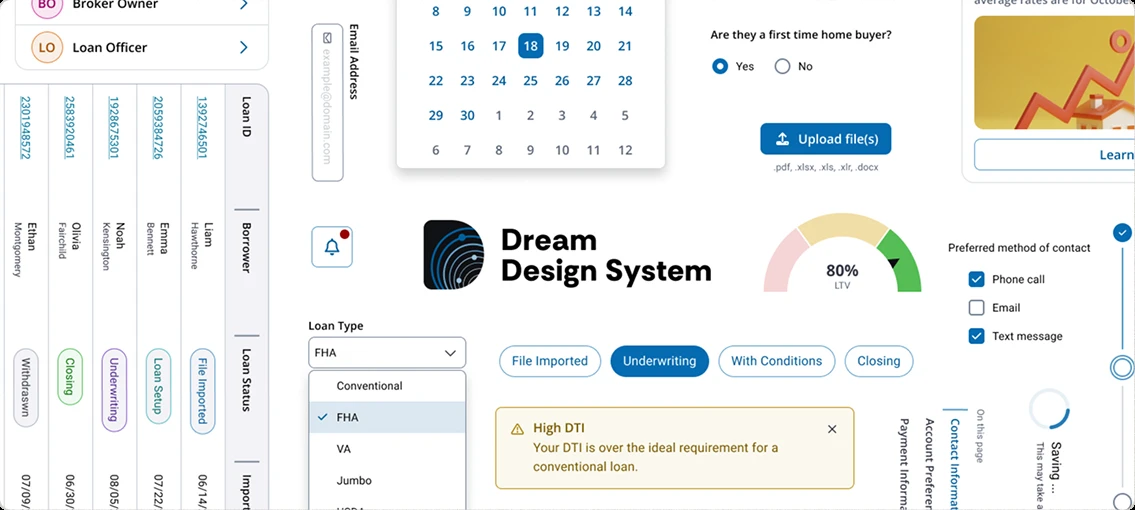
Co-founded a design system from scratch with 4 designers and 5 developers at UWM — grew from 50 to 85 components across 56 active projects, with 55% adoption today.
ROLE
Designer
YEAR
3 years, ongoing
TYPE
Professional
COLLABORATORS
Designers, Developers, Architecture, Business Analyst
i. The Problem
Before Dream, UWM's products suffered from inconsistent UI, slow design-to-dev hand off, duplicated engineering work, and no accessibility standard. We first raised the idea of a real design system back in September 2023, and it took nearly a year of building the case before Dream became an officially backed team in August 2024.
ii. The Process
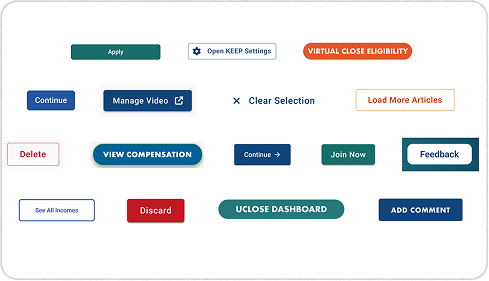
None of us had built a design system before, so we leaned on research to inform how each component was built, documented, and used. Once research concluded, the component would then be designed in Figma and handed off to development for implementation. Throughout the process, designers and developers were always collaborating and communicating with each other. Designers would look at visual outputs from development, and developers would review Figma for property and layout specs.
Governance ran on majority vote rather than one person calling the shots, making sure everyone was aligned and everyone's voice was heard. Even with that structure in place, we knew we couldn't anticipate every use case ourselves, so we built a contribute and commit model, letting any designer or developer propose changes so the system evolved with real feedback rather than our assumptions.
My contributions:
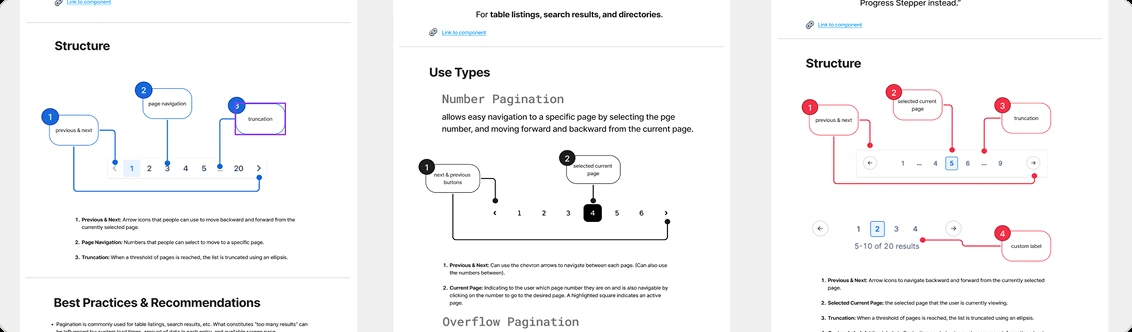
I standardized the team's research process, designed several components, launched a 1-year satisfaction survey, ran observability sessions, reviewed and consulted on designs that the design team requested, and hosted training sessions.
iii. The Results
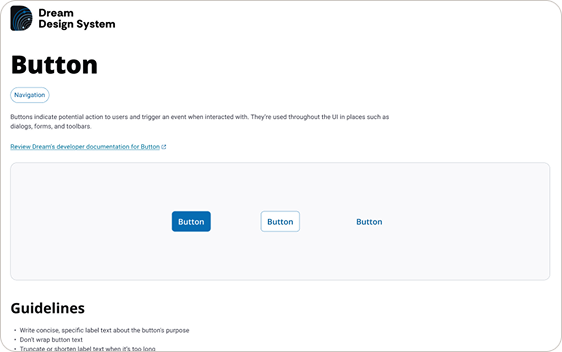
UI Library
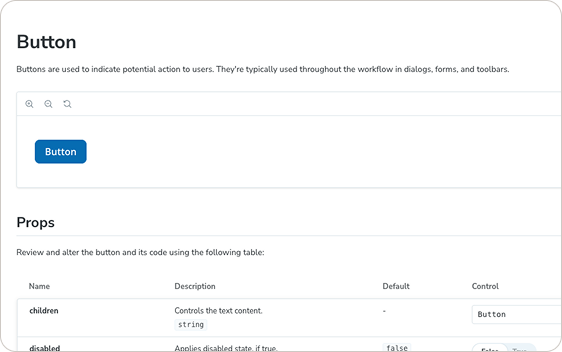
A component library in Figma + Storybook, full component documentation on guidelines and patterns, shared design tokens, and two themes.
Adoption & scale
Since launching with 50 components, Dream has grown to 85 components across 56 active projects, with 55% adoption today. Greenfield projects are largely required to use Dream; legacy systems are migrating over gradually. The system has shipped 4 major releases to date.
Community engagement
The contribute & commit model has driven 179 pieces of consumer feedback implemented (tracked via Airtable), turning outside input into real system changes rather than requests that go unanswered. Separately, the team has conducted 21 design consultations — an offered service where designers can check their work against Dream standards, though not yet an embedded step in project workflows, as the UX team is still refining how review gets built into the process.
One-year benchmark survey
Around Dream's one-year mark, I surveyed designers and developers to benchmark satisfaction and surface gaps. Designers were 100% satisfied or somewhat satisfied; developers were 83%. Top praise: team support and documentation. Top pain point: more flexibility to match mockups one-to-one.
Designers (n=11 of 20)
- Satisfied
- Somewhat Satisfied
Developers (n=19 of 59)
- Satisfied
- Somewhat Satisfied
- Neutral
- Somewhat Dissatisfied
That same flexibility gap showed up independently in observability sessions, where designers repeatedly detached complex components likes data grid, for example, from its Figma instance — confirming the pattern was real, not a one-off issue.
iv. What's next
Auditing every component for flexibility, building an MCP server so AI-generated work stays on-standard, migrating legacy systems, and rearchitecting the system to be more agentic friendly.
v. Reflection
The hardest part was the uncertainty — none of us had done this before, and not everyone welcomed an enforced standard. But working on Dream taught me to think beyond, since a design system is itself an experience after all. That shift made me a more confident, systems-minded designer.
I would have liked more time in building the system, since its first launch rode on the back of a major project, taking the opportunity to prove the system's value. This did cause some quick decisions and compromises to deliver on time, but it was still the system's best opportunity to prove itself.
View more work
Let's connect

© 2026 Mirreille Pelak, Detroit Area, Michigan
mirreille.pelak@gmail.com